

There is a now a substantial decline in the amount of time that gas prices dictate the costs of wholesale electricity in the UK. This will reduce consumer costs. In addition, renewable generation that does not receive any form of incentives from the state is forming a major part of the UK electricity mix. As far as the national consumer is concerned, such generation is ‘too cheap to meter’.
By contrast, fossil fuel and nuclear power plants continue to receive a raft of special incentives from the state. An increasing quantity of renewables, including imports from abroad, is reducing the amount of gas used in the UK electricity system. Crucially, they are also now reducing the amount of time that gas power plants form the marginal price that sets the price for all wholesale electricity.
Meanwhile, debate in the UK is dominated by an argument about whether there should be more UK oil and gas drilling. This is at best irrelevant to costs faced by UK energy consumers and at worst merely puts resources into fossil fuel extraction when they ought to be going to fossil fuel reduction. Ironically, the Conservative/Reform/Scottish Labour politicians who are keenest on more oil and gas drilling propose to reduce ‘windfall profits’ taxes on oil and gas profits, thus taking money out of consumers’ pockets.
Reducing gas domination
In recent years, wholesale electricity prices have been set in the UK mainly by gas power stations. This is because their generation is usually, at any given time, the most expensive. Electricity prices are set by the most expensive ‘marginal’ packet of electricity offered and bought on the system each half hour. Hence, during the energy crisis of 2022 electricity prices leapt upwards regardless of the existence of much cheaper renewables. However, things are changing in that the amount of time that gas power sets wholesale electricity prices is in substantial decline.
According to a post on linkedin by Ed Porter from the Modo energy consultancy gas power’s influence on UK electricity prices is declining. Comparing March 2026 with previous years he found that in March 2026 gas formed the wholesale electricity price for around 67% of the time compared to just over 90 per cent of the time in March 2022 (see chart published HERE). This is part of a general decline in the influence of gas in setting the UK’s wholesale power prices as the proportion of gas used in electricity generation is falling.
This is significant because it means that the reduced exposure to higher gas prices during March is because of the increase in share of generation from renewables. Wholesale prices associated with renewables are very low. Electricity consumers will gain from this by having lower electricity bills than if the proportion of generation from gas was higher.
Spain, for example, also uses gas to balance fluctuating renewables. In Spain the link between gas generation prices and wholesale electricity prices has largely been broken, even though Spain has a higher proportion of electricity from wind and solar compared to the UK. You can see how gas is declining as a source of electricity generation in the UK in Figure 1. Renewables are increasing in importance. This is both directly, but also in the shape of imports of (mainly) excess renewables from the continental interconnectors from France, Norway, Belgium and Denmark.
Figure 1
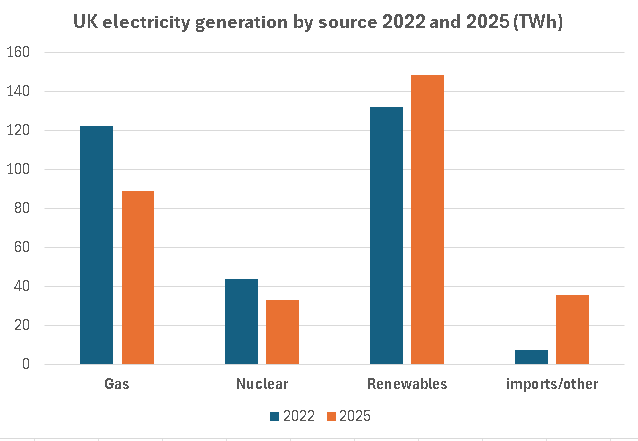
Source: Energy Trends March 2026, UK Department of Energy Security and Net Zero
The Cheapest electricity sources: onshore solar and wind
Not only is solar PV and onshore wind cheapest as revealed by the results of Government auctions for contracts for difference (CfDs), but they are obviously also cheapest for another reason. Large amounts of solar PV and wind power are installed without any contracts or incentives from the Government at all. This is more than can be said for existing gas fired and nuclear power plant, which receive so-called ‘capacity mechnism’ incentives, and new nuclear power plant which is increasingly given a blank cheque (the Government is effectively saying ‘don’t worry about cost overruns for Sizewell C, old chap, we’ll pay for them’). Indeed, by wanting to prioritise new gas fired power plant rather than renewables and batteries, the Reform/Conservative Opposition will (if they gain office) incur massive costs to promote more gas power under the capacity mechanism.
Indeed, according to Zach Jennings (another guy from Modo Energy) some 8.6 GW of solar PV doesn’t receive any sort of incentive from Government (See HERE). This 8.6 GW consists, as I estimate, of at least 3 GW of solar farms and the rest being rooftop solar PV. The solar farms are financed from PPAs (power purchase agreements) from big energy consumers. There are also, on top of this, some windfarms financed solely on the back of PPAs. These include the Kintyre, Halsary and Inverclyde windfarms in Scotland. All told this ‘too cheap to meter’ renewable energy constitutes around 3 per cent of Uk electricity generation.
It is probable that all or most onshore wind and solar farms now given Government CfD contracts could also be financed this way - if only there were enough big energy consumers willing to offer contracts to supply them with electricity. After all, retail rates for electricity are higher than the wholesale rates that they will have available under CfDs (in parallel with other industries). The limitation is that lenders will only usually underwrite prospective projects if there is a really big company offering a firm long-term contract to consume the electricity from the projects. So the projects could not be financed, in effect, without the guarateed income stream of a CfD).
Only big companies are given high enough credit scores by the credit rating agencies to offer valuable PPAs. That is PPAs whch can be used to persuade banks to lend money to the renewable projects. Yet there are only so many Tescos and Amazons around and interested at any one time in offering PPAs to new solar or windfarms. Hence the number of projects that can be financed this way are limited. The big electricity suppliers (who control most of the supply contracts) can offer PPAs. However, they will certainly not offer retail rates to independent electricity generators - they wouldn’t make any profits that way!
Around 7 GW of solar farms have been installed on the back of Government incentives and contracts. This is partly though earlier feed-in tariff and renewable obligation arrangements, but now increasingly through CfDs. CfDs are, from the consumer point of view, an especially efficient way of installing solar PV since the guranteed prices offered under the contracts helps projects borrow from banks at low rates. This produces cheap schemes. Indeed in the most recent AR7a round of UK Government CfD auctions solar PV and wind power came in at £65 per MWh to £72 per MWh - almost exactly half the amount to be paid to EDF for Hinkley C.
Over 5 GW of solar PV without any incentives is now installed on rooftops. This is in addition to a broadly similar amount of rooftop solar installed under the earlier regime of feed-in tariff incentives. Rooftop installation has been boosted by the 2022 gas crisis, and it is receiving a further boost from the 2026 oil crisis. All in all, as of early 2026, around half the 21 GW of solar PV installed in the UK was on rooftops and half was in ground-mounted solar PV. Currently, solar farm installation is outpacing rooftop installation. However, rooftop solar PV is getting a boost from the effect of changes to standards for new buildings.
Conclusion
Onshore solar PV and onshore wind are, in many cases, ‘too cheap to meter’ since their electricity is bought privately at absolutely no cost to energy consumers in general. They also require little in the need of electricity network extensions. Indeed solar PV in particular is often embedded generation that will actually make much more efficient use of existing network connections. Yet, Opposition politicans seem to be falling over themselves to demand that solar farms and windfarms be stopped. Meanwhile, the amount of gas power that the UK needs for electricity generation is being steadily reduced by increased use of renewable energy.
Of course, we need offshore wind to do a lot of heavy lifting in order to aim for net-zero targets. But we also need to boost electrification by shifting transport and heating from being powered by gas to be powered by renewable electricity. Then we can make better use of the extensions in electricity networks that are planned - and, most of all, make progress on energy security and the climate crisis by replacing fossil fuels with low- carbon energy sources.
Enough RE and enough storage and it starts to be reflected in reduced reliance on gas - which is reflected in prices. Being cheaper but not much of them isn't enough. No going back - tipping points have been crossed - but the transition can be accelerated or slowed.
This is a useful corrective to a lot of the current energy debate.
The key point is not just that renewables are cleaner. It is that they are already weakening the link between gas prices and electricity prices. That matters because gas has acted as the price-setter in the UK electricity market for far too long, even when cheaper renewable power is available on the system.
The Scottish angle is obvious. The question is not whether Scotland has renewable potential. It clearly does. The question is whether that potential is captured as public value, lower bills, stronger communities and industrial capacity, or whether it simply becomes another asset class owned elsewhere.
Energy security should not mean clinging to gas. It should mean reducing exposure to volatile fossil fuel markets, building grid and storage capacity, and making sure the gains from Scotland’s renewable resources are shared more fairly.